
BioSource dMRV
Streamlined compliance for quicker carbon credit turnarounds
4 hrsreport compiling saved each week
Explore case study
A focused conversation about how your business runs and where AI could help — and where it would not.
Book a free review →Two Lead Assessors were spending their days chasing bills and reconciling spreadsheets instead of exercising judgement. Now the documents read themselves into one record per client, and the assessors sign off rather than assemble.

Our client is a twelve-person energy and carbon consultancy working with mid-sized manufacturers, logistics operators and multi-site retailers across the UK. Two of its consultants are registered ESOS Lead Assessors; the rest are energy analysts and carbon accountants. The firm delivers around forty SECR disclosures a year, supports thirty clients through ESOS, and runs a growing carbon strategy practice covering SBTi target-setting, net zero roadmaps and Carbon Reduction Plans. The expertise was never the constraint. Getting the data into a state where that expertise could be applied was.
With its ESOS pipeline building and its SECR book expanding, the firm was turning work away because its two Lead Assessors were spending most of their time on data rather than judgement. Hiring another Lead Assessor would have taken a year and still left the underlying process unchanged.
Chasing utility bills, reconciling meter exports against invoices, and rebuilding the same consumption dataset in a fresh spreadsheet for each scheme.
Supplier PDFs, photographs of bills, half-hourly exports, fuel-card statements, mileage claims, F-gas registers and waste notes. No two clients send the same formats, and someone had to read every one of them.
A client's SECR data and its ESOS data were collected twice, by different people, in different formats, and the two rarely agreed at the first pass.
Hiring another Lead Assessor would have taken a year and still left the underlying process unchanged.
Every client profile runs through deterministic tests for ESOS, SECR, PPN 006, CCA, TCFD, SBTi and ISO 50001. Each verdict carries its reason and the rule behind it, and re-evaluates the moment staff, turnover or balance-sheet figures change. Where the rules do not reach, the regulations themselves can be questioned directly and answered with the clause cited.
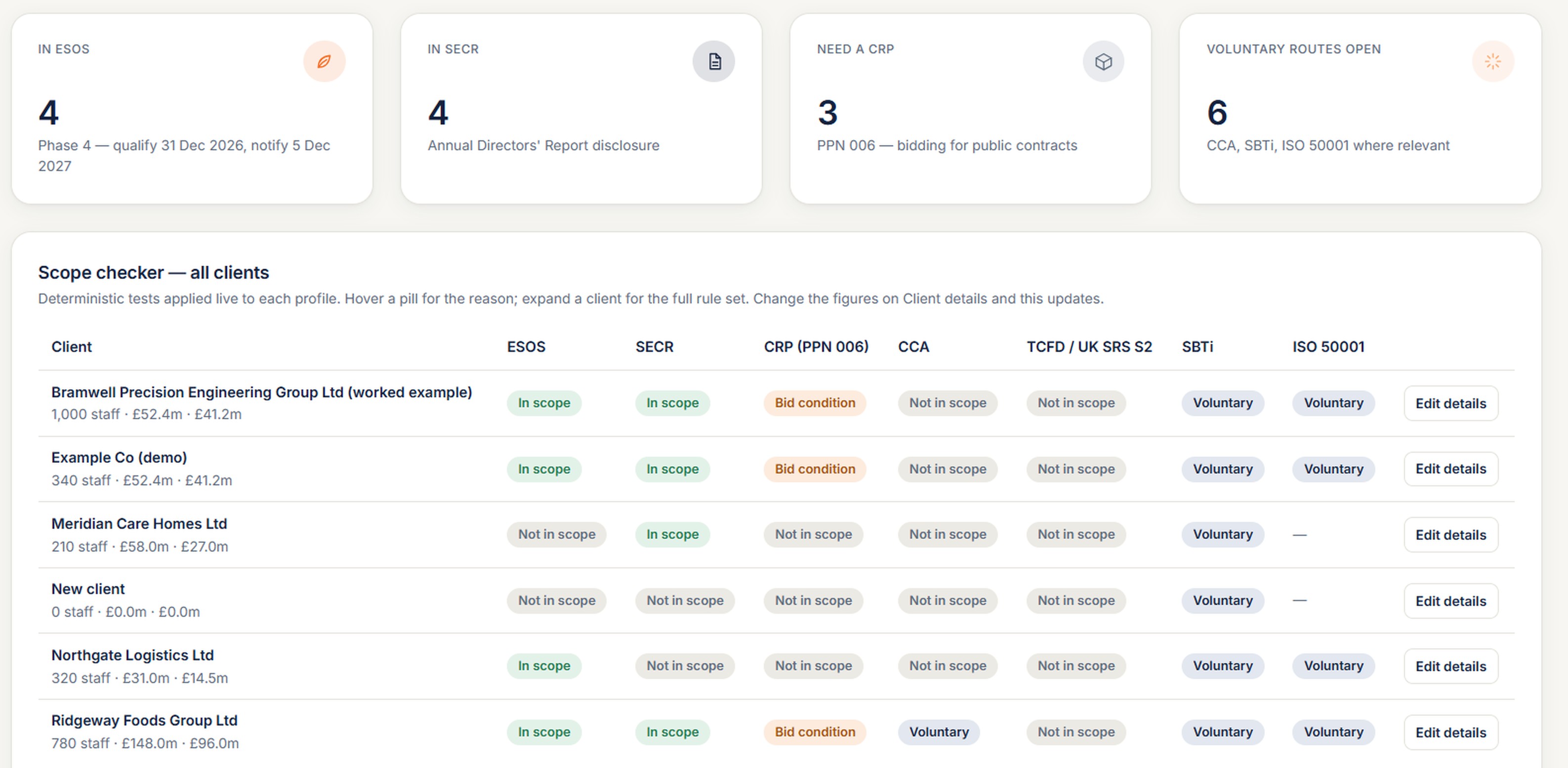
Six clients screened against seven regimes at once, each verdict carrying its reason.
Half-hourly exports, supplier bills, bill photos, fuel-card statements, mileage claims, F-gas registers and waste notes go in as they arrive. Each file is read, parsed and mapped to a site, meter or Scope 3 activity, and the coverage grid shows month by month where data is real, estimated, missing or contradictory.
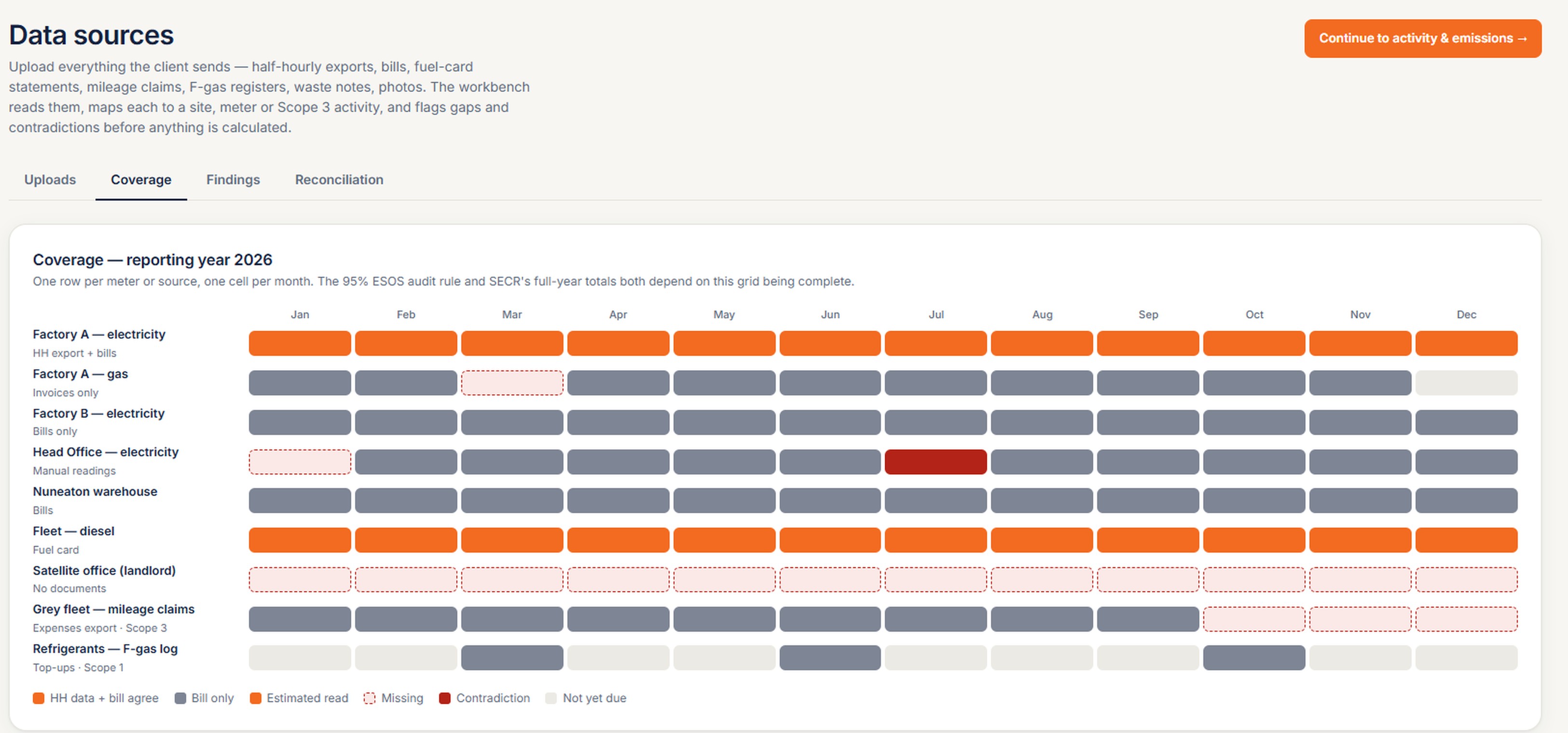
A year of bills, meter data and mileage reconciled into one grid — before a single number is calculated.
Energy in kWh and emissions by scope are held once per client, and ESOS, SECR and the Carbon Reduction Plan are each a view of it. Scope 3 categories are labelled with the regime that requires them, so the same activity data satisfies several filings without being rebuilt.
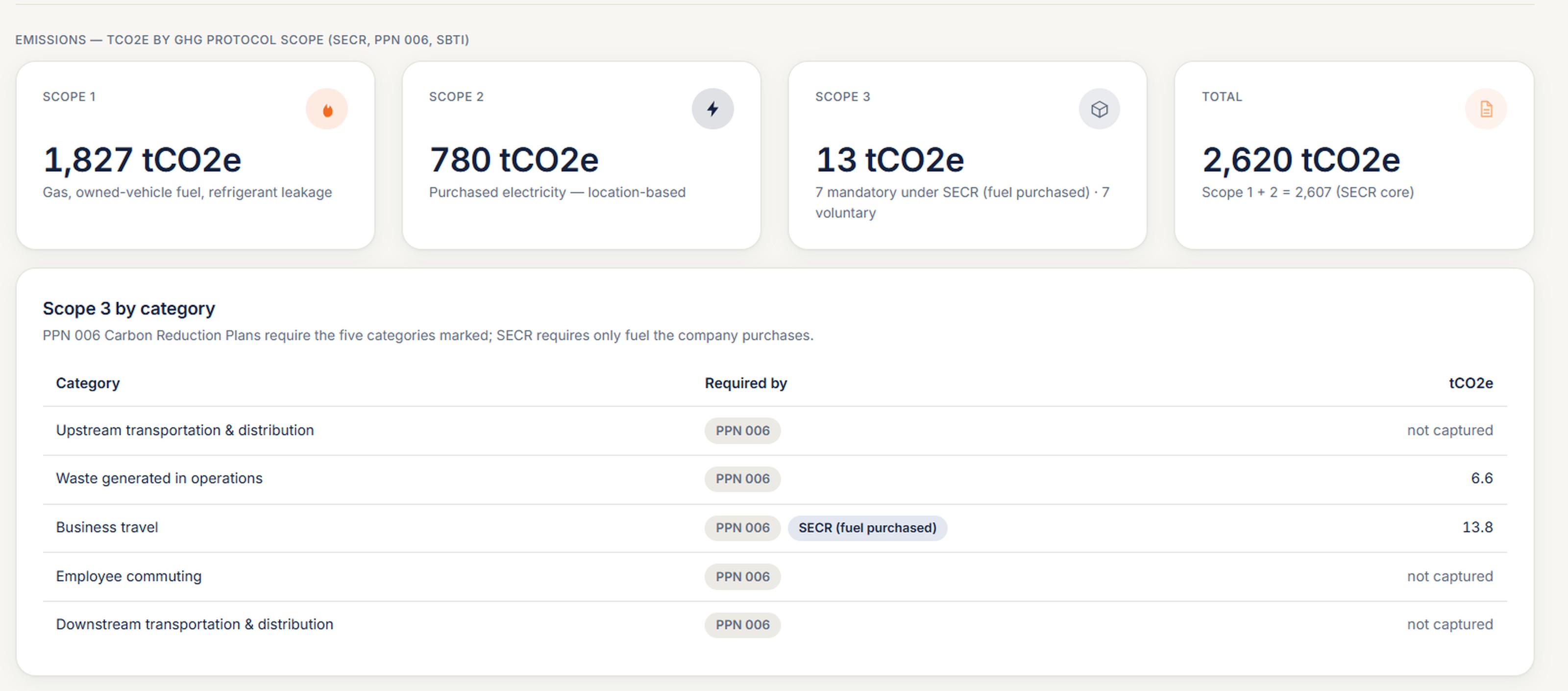
One set of numbers, three filings, with each Scope 3 category tagged to the regime that requires it.
ESOS runs as twelve stages, from qualification through the 95% coverage test to sign-off. The platform drafts measures and narrative from the client's own records, but each stage stays open until the Lead Assessor records a decision and the basis for it.
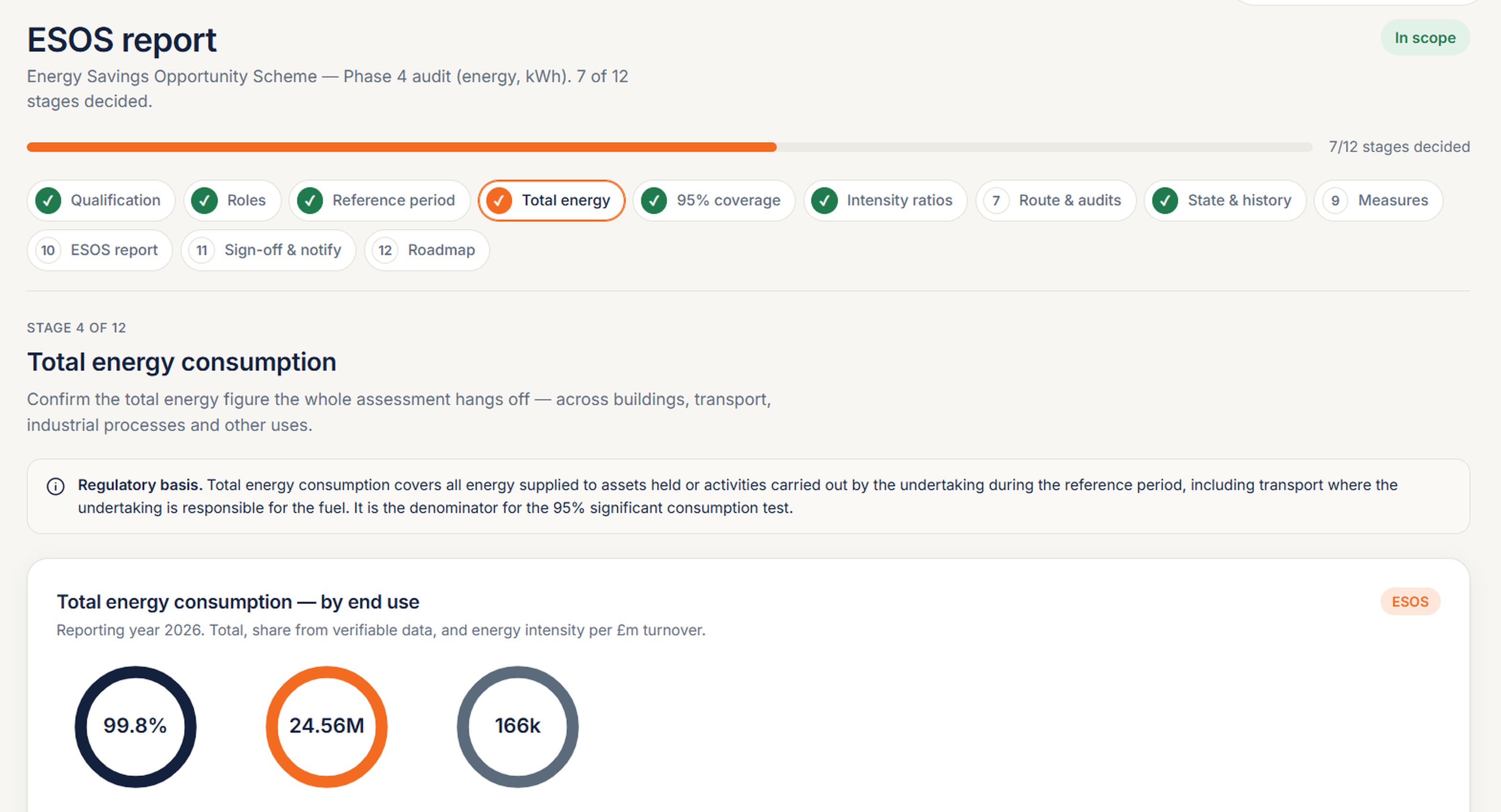
Seven of twelve stages decided — the report cannot be filed until the rest are.
The firm took on more work, sold more from the same data, and kept every decision with a named assessor:
Tell us about the process or manual check that is slowing you down. We will tell you plainly whether AI is the right answer.
Get in touch
A focused conversation about how your business runs and where AI could help — and where it would not.